
Where drone logistics makes sense
Drone delivery headlines usually focus on parcels to suburban homes. The strongest business cases today are often less glamorous: getting essential items to places that are hard to reach. A spare part for a mountain telecom mast. Medicines across a river during the rainy season. Tools to a wind turbine nacelle. Supplies to an island when the ferry is cancelled.
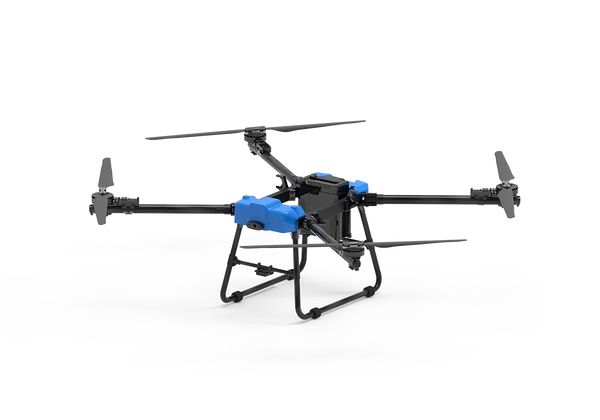
Payload Drone
D50 Transport Drone
50 kg payload transport drone rated to 5000 m altitude and 10 km range, built for mountain and long-distance cargo.
- Max payload50 kg
- Range10 km

Payload Drone
P50 Heavy Lift Drone
50 kg payload heavy-lift drone for delivery, firefighting support, rescue drops and industrial inspection.
- Max payload50 kg
- RoleCargo / rescue / firefighting

Payload Drone
THEA 200MP Coaxial Octocopter
8-axis coaxial heavy-lift octocopter rated for 70 kg payload with up to 45 minutes endurance.
- Max payload70 kg
- EnduranceUp to 45 min*
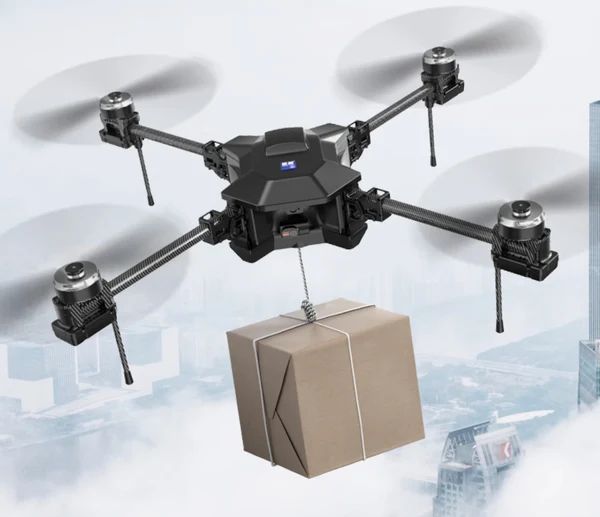
Payload Drone
SY800 Heavy Lift Drone
2–10 kg payload drone with 10 km range, 3-axis 1080P/2K camera, GPS, thrower, loudspeaker and lighting.
- Payload2–10 kg
- Range10 km
Logistics use cases
Remote infrastructure resupply
Telecom repeaters, weather stations, research huts, mountain refuges and border facilities. The D50 (50 kg, 10 km, rated to 5000 m) is designed for exactly these routes.
Island and coastal routes
Short sea crossings for urgent parts, medicines and samples, avoiding boat charters for small loads.
Site-to-site industrial logistics
Moving parts and tools across large mines, plants, ports and construction sites without vehicle trips. See mining and construction.
Urgent parts
When a machine is down, the cost of waiting for a vehicle can exceed the cost of the drone flight many times over.
Humanitarian logistics
Supplies to communities cut off by floods, landslides or conflict-damaged roads. See public safety and emergency response.
Matching aircraft to routes
| Route type | Typical load | Suggested platform |
|---|---|---|
| Short, repeated heavy shuttles | 20–50 kg | THEA 190MP |
| Long, high-altitude routes | Up to 50 kg | D50 |
| Heaviest single loads | Up to 70 kg | THEA 200MP |
| Mixed cargo and rescue | Up to 50 kg | P50 |
| Small parcels over distance | 2–10 kg | SY800 |
Building a drone logistics operation
- Pick a route with a clear pain point and measurable value
- Survey it for terrain, obstacles, population, airspace and radio coverage
- Calculate performance for payload, distance, altitude, wind and temperature
- Secure approvals. Most cargo routes, especially beyond visual line of sight, need specific authorisation.
- Design ground operations: loading points, drop zones, battery logistics and weather limits
- Run a trial, measure, then scale
Economics
Drone logistics usually wins on routes where the alternative is expensive (helicopter, boat charter, long detour), slow (hours or days), or risky (people carrying loads over dangerous ground). Count aircraft, batteries, crew, approvals, insurance and maintenance against those savings.