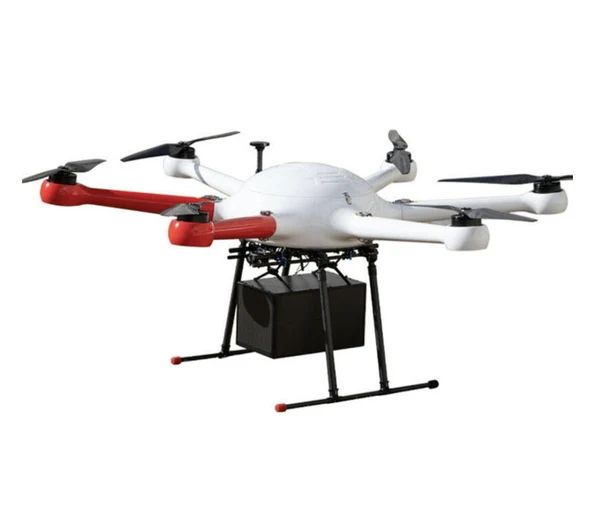
A payload drone is a drone designed to carry something other than its own built-in camera. The "payload" is whatever the drone carries to do its job: a parcel, a spray tank, a LiDAR scanner, a thermal camera, a loudspeaker, a searchlight, a life ring or a bait rig. In a payload drone, the aircraft exists to carry the payload. Choosing one starts with the payload, not the drone.
Payload: the core idea
Every drone has a lift budget: the total weight its motors and propellers can lift with a safe margin. That budget is shared between:
- The airframe: frame, motors, electronics, landing gear
- The batteries
- The payload
The payload capacity is what is left for the useful load after the airframe and batteries. A drone rated for a 50 kg payload, like the P50, can carry up to 50 kg of cargo or equipment on top of its own weight.
Payload vs MTOW
Two numbers appear on drone specification sheets, and confusing them is the most common buying mistake:
- Payload: what you can carry
- MTOW (maximum take-off weight): the total weight of everything combined, including airframe, batteries and payload
A drone with a 55 kg MTOW, like the GAIA 190MP, does not carry 55 kg of cargo. Subtract the airframe and battery weight to find the payload. And because battery weight varies with configuration, more battery means more flight time but less payload.
Flight time and payload
Flight time is not a fixed number. It falls as:
- Payload increases, because the motors work harder
- Wind increases
- Temperature drops, because batteries deliver less energy in the cold
- Altitude increases, because thinner air means less lift per rotor turn
- Batteries age
Manufacturer flight times are usually measured at light or zero payload in good conditions. Expect much less at full load. Always ask for flight time at your payload.
Airframe layouts
| Layout | Rotors | Strengths | Trade-offs | Example |
|---|---|---|---|---|
| Quadcopter | 4 | Efficient and simple, fewest parts | Little redundancy | THEA 220MP |
| Hexacopter | 6 | More margin after a motor problem | More parts than a quad | GAIA 160MP |
| Octocopter (flat) | 8 | High thrust and redundancy | Large footprint | — |
| Coaxial octocopter | 8 (4×2 stacked) | High thrust in a compact frame, redundancy | Some efficiency loss | THEA 190MP, THEA 200MP |
Types of payload
Cargo
Boxes, hooks, winches and drop releases for moving goods. See cargo drones.
Agricultural
Spray tanks and spreaders. See agricultural drones.
Sensors
LiDAR, mapping cameras, multispectral, thermal and zoom cameras, and gas detectors. See survey drones and inspection drones.
Public safety modules
Loudspeakers, searchlights and throwers. See the MX4-10.
Specialist
Water samplers, line-stringing equipment, bait releases and custom equipment. See custom payload drones.
Payload interfaces
How the payload attaches matters as much as how heavy it is:
- Mechanical: mounting points, quick-release, vibration isolation
- Electrical: power supplied to the payload from the aircraft
- Control: triggering a release or camera from the ground station
- Data: recording or streaming sensor data
A drone that can lift your sensor but cannot mount, power or control it is not the right drone.
Payload classes
- Light (under 5 kg): fishing drones, small rescue drops, sensors. Example: SwellPro FD2 (3.2 kg).
- Medium (5–20 kg): survey sensors and small cargo. Examples: MX4-10 (5 kg), SY800 (up to 10 kg), GAIA 160MP (20 kg).
- Heavy (20–55 kg): cargo, construction and utilities. Examples: THEA 220MP (40 kg), P50, D50 and THEA 190MP (50 kg).
- Ultra heavy (over 55 kg): THEA 200MP (70 kg).
Regulation follows weight
The heavier the drone, the more regulation applies. In the US, Part 107 covers aircraft under 55 lb (about 25 kg). In the EU and UK, the open category stops at 25 kg MTOW. Heavier operations need specific approvals. See our resources page.
How to choose a payload drone
- Define the payload: typical weight, dimensions, power and data needs
- Define the mission: distance, frequency, altitude, weather
- Choose a platform whose rated payload comfortably exceeds your typical load
- Confirm flight time at your payload
- Check the payload interface
- Check regulations and approvals
- Budget for the full system: batteries, chargers, spares, training
Read best payload drones for model-by-model recommendations.
Frequently asked questions
What does payload mean on a drone?
The weight of useful equipment or cargo the drone can carry in addition to its own airframe and batteries.
What is the difference between payload and MTOW?
MTOW is the total maximum weight including the drone, batteries and payload. Payload is only the useful load.
Does payload affect flight time?
Yes, significantly. More payload means shorter flight time.
What is the heaviest payload a drone can carry?
In our range, 70 kg (THEA 200MP). Specialist systems elsewhere carry more, under heavier regulation.