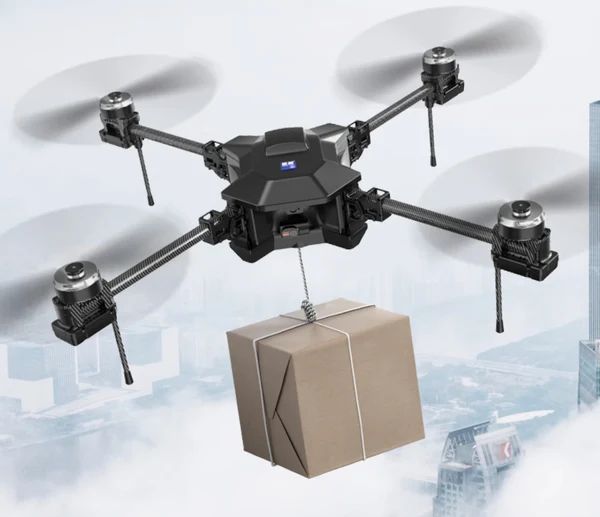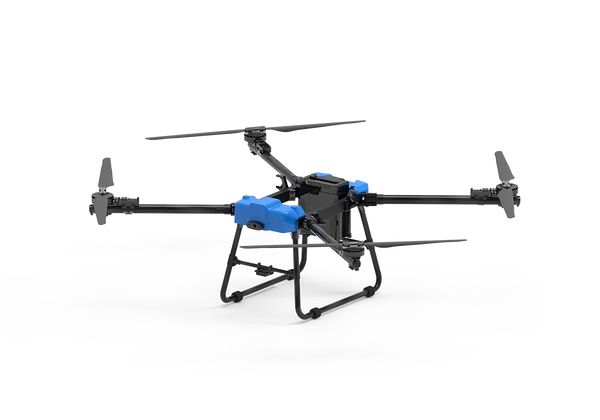
Cargo drones look simple: rotors, a frame and a box or hook underneath. Behind that is a set of technologies that determine how much a cargo drone can carry, how far, how safely and how reliably. Understanding them helps you choose the right aircraft and plan realistic operations.
1. Airframe
The airframe carries everything. For cargo work, look at:
- Layout: quadcopter, hexacopter or coaxial octocopter (see what is a payload drone?). Coaxial layouts like the THEA 200MP give high thrust and redundancy in a compact frame.
- Materials: carbon fibre and aluminium for stiffness and low weight
- Folding arms: for transport between sites
- Landing gear height: clearance for cargo boxes or hooks
- Cargo bay or hardpoints: where and how loads attach
2. Propulsion
Motors, electronic speed controllers (ESCs) and propellers turn battery energy into thrust.
- Larger propellers spinning slower are generally more efficient than small, fast ones. That is why heavy lifters have big props.
- Motor and ESC sizing must leave headroom above hover thrust for manoeuvring, wind and redundancy
- Thermal management matters at high loads and in heat
3. Energy: batteries
Most cargo drones use lithium battery packs. The fundamental limit on cargo drones is energy density: every kilogram of battery is a kilogram not available for cargo.
Key points:
- Capacity vs payload trade-off: more battery gives more range and less cargo
- Temperature: cold reduces available energy, and heat accelerates ageing
- Altitude: thinner air means more power is needed for the same lift
- Shipping: lithium batteries are Class 9 dangerous goods. See IATA guidance.
Some long-endurance systems use hybrid (fuel-electric) power, which brings different trade-offs and regulations.
4. Delivery mechanisms
How cargo leaves the drone shapes the operation:
| Mechanism | How it works | Best for |
|---|---|---|
| Land and unload | The drone lands, cargo is removed | Fragile goods, controlled sites |
| Hook / sling load | Load hangs below on a line | Bulky or heavy loads, no landing needed |
| Release / drop | The load is released at low height | Robust items, rescue drops |
| Winch | The load is lowered on a tether | Delivering without landing, over obstacles |
| Cargo box | Enclosed container | Weather-protected goods |
Suspended loads swing in wind and need careful handling and limits.
5. Navigation
- GNSS (GPS and others) for positioning and waypoint navigation
- RTK for centimetre-level precision where needed
- Inertial sensors and magnetometers for attitude and heading
- Altitude sensing with barometers, plus radar or lidar altimeters for terrain following
Waypoint missions let cargo drones fly repeatable routes. The SY800, for example, uses GPS waypoint navigation.
6. Command and control links
The radio link between the ground station and the aircraft carries control commands and telemetry, and often video. For long routes:
- Range and reliability depend on power, antennas, terrain and interference
- Redundant links improve reliability
- Lost-link behaviour (return home, hover, land) must be configured before every flight
Rated ranges, such as 10 km for the D50, assume good conditions. Hills, buildings and interference shorten them.
7. Safety systems
- Redundant motors (hexa and octo layouts)
- Dual batteries on some designs
- Geofencing to keep aircraft out of restricted areas
- Return-to-home and failsafe landing
- Parachute systems on some aircraft for ground-risk mitigation
- Lights and transponders for visibility to other airspace users
8. Route planning
Technology only works within a well-planned operation:
- Survey terrain, obstacles, power lines and population
- Check airspace and approvals
- Calculate performance with real payload, wind, temperature and altitude
- Define take-off, landing and drop zones
- Define contingency landing sites
- Set weather limits
Cargo drones in our range
- D50: 50 kg, 10 km, rated to 5000 m. Long routes and altitude.
- P50: 50 kg. Flexible heavy cargo, rescue and firefighting.
- THEA 200MP: 70 kg. Heaviest loads.
- SY800: 2–10 kg, 10 km, camera. Light parcels.
Frequently asked questions
What limits how far a cargo drone can fly?
Mainly battery energy versus weight, plus wind, temperature, altitude and link range, and regulations.
Do cargo drones need to land to deliver?
No. Hooks, winches and drop releases deliver without landing.
Are cargo drones autonomous?
Many fly pre-planned waypoint missions, supervised by a pilot. Fully autonomous operations need advanced systems and approvals.
What happens if a cargo drone loses signal?
It follows its configured failsafe: typically return-to-home, hover or land.