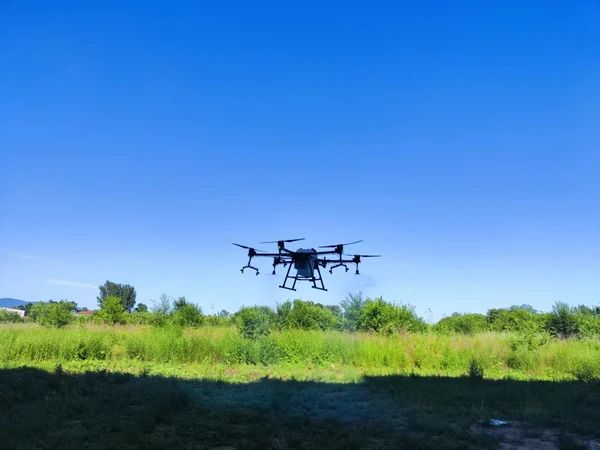
Agricultural drones are among the most widely adopted drones in the world. In rice paddies, palm plantations, orchards, vineyards and broadacre fields, they apply crop-protection products, nutrients and seed without driving on the soil. This guide explains how they work, what makes an operation productive, and the rules you need to know.
What agricultural payload drones do
Spraying
Applying liquid crop-protection products and foliar nutrients through nozzles, with the rotor downwash helping push droplets into the canopy.
Spreading
Broadcasting seed (cover crops, rice, pasture) and granular fertiliser from a spreader unit.
Scouting and mapping
Camera and multispectral surveys to find problems and target treatments. These usually use a separate survey platform such as the GAIA 160MP.
Why farmers adopt them
- No soil compaction, with no tyre tracks on wet or fragile soils
- No crop damage from wheels or tramlines
- Access to steep, terraced, wet or small irregular fields
- Timeliness: spray when the crop needs it, not when the ground allows
- Operator safety: no walking through spray with a backpack
- Precision: GPS lines and controlled rates
The TTA G300
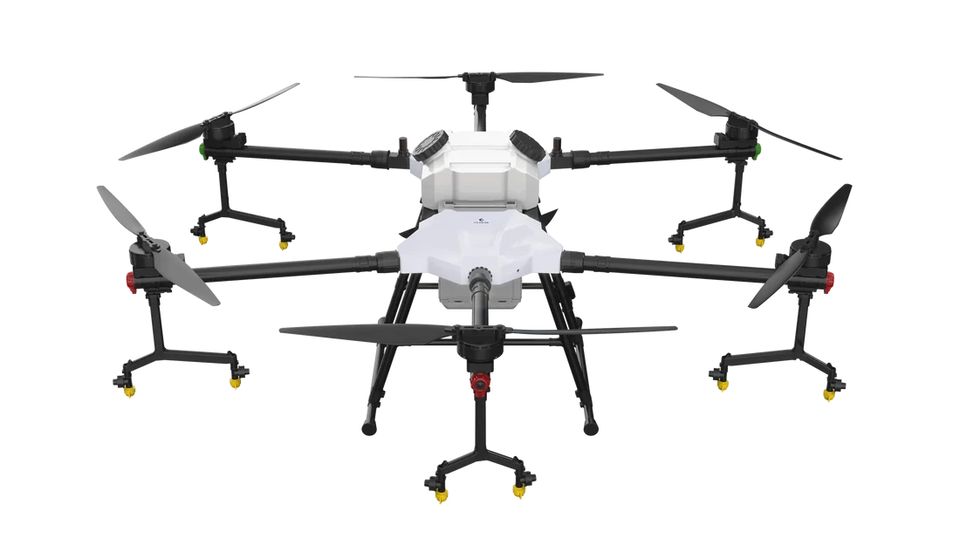
The TTA G300 is a six-axis agricultural drone with a 30 L tank, rated at about 24 acres (≈9.7 ha) per hour, configurable for spraying and seed spreading.
What really determines work rate
The rated work rate is achieved only when logistics keep up. The drone spends time:
- Spraying (productive)
- Ferrying between field and refill point
- Refilling the tank
- Swapping batteries
- Waiting for charging, mixing or weather
Productive crews:
- Set up the mixing and refill station close to the field
- Have enough batteries and charging capacity for continuous rotation
- Pre-plan flight lines with boundaries and obstacles mapped
- Use a two-person team: pilot and loader/mixer
- Keep application volume (litres per hectare) appropriate. Higher volumes mean more refills.
Drift and application quality
- Wind: respect label and regulatory wind limits
- Height and speed: follow recommended settings for the product and crop
- Nozzles and droplet size: larger droplets drift less
- Temperature and inversions: avoid spraying in temperature inversions
- Buffer zones: respect buffers near water, homes and sensitive crops
- Records: product, rate, area, time, weather and operator for every job
The rules
Agricultural drones are regulated twice.
As aircraft
- United States: drone rules (Part 107 for aircraft under 55 lb, exemptions for heavier) plus Part 137 for agricultural aircraft operations. See the Part 137 text and the FAA.
- EU: drone operations under the EU framework, usually in the specific category for spray drones.
- Elsewhere: many countries, particularly in Asia and Latin America, have dedicated agricultural drone approval routes. See your country page.
As pesticide application
- Products must be approved for drone or aerial application in your market
- Operators often need pesticide applicator licences
- In the EU, aerial spraying of pesticides is generally prohibited except under specific derogations, and national approaches to drones vary
- Label instructions are legal requirements
Always check with both your aviation authority and your agriculture or pesticide regulator.
Running a spray contracting business
Many G300 buyers become contractors, serving their own farm and neighbouring farms:
- Price per hectare, accounting for travel, product handling and minimum job size
- Insurance covering liability and drift claims
- Scheduling around weather windows, so book clusters of nearby jobs
- Records for clients and regulators
- Reputation from good results, careful drift management and reliability
Maintenance
- Rinse the spray system after every job
- Check nozzles, filters and pumps
- Clean residues from the airframe and motors
- Inspect arms, props and connectors
- Follow battery care rules, especially in heat
Frequently asked questions
How much can an agricultural drone spray in a day?
It depends on the work rate (about 24 acres per hour rated for the G300), hours flown and logistics. Efficient crews achieve much more than slow ones with the same drone.
Is drone spraying legal?
It is legal where you meet aviation and pesticide rules. In the US that includes Part 137. In the EU, aerial spraying is generally restricted.
Can spray drones apply fertiliser?
Yes: liquid foliar products by spraying, and granular fertiliser with a spreader.
Do spray drones work on tall crops and orchards?
Yes. Downwash helps push droplets into the canopy. Settings vary by crop.